


Indoor plants Miltonia
Description
Special Features of Miltonia
Miltonia is a genus of perennial herbaceous plants of the orchid family Orchidaceae. According to the Royal Botanic Gardens, Kew (a complex of gardens and greenhouses with a major research and training center located in London and well-known and recognized all over the world), the genus includes 11 original species and 7 natural hybrids. There are about four dozen of artificial hybrids obtained from Miltonia.
Orchids are the largest and probably the most ancient family of ornamental plants that are mostly famous for their amazing showy flowers. Some species also have attractive foliage.
Formal biological descriptions of orchids often use the terms "sympodial" and "pseudobulb". A pseudobulb (or "false bulb") is a thickened part of the stem that stores nutrients (including water) for the leaves and / or stalks. The "sympodial" growth is the most advanced type of growth pattern; there are other simpler types, monopodial and dichotomous. Miltonia is characterized both by sympodial growth and pseudobulbs (rather small, though).
Miltonia first came to Europe from South America. Its endemic area is rather small and includes several states in central and southern Brazil, eastern Paraguay between the Paraguay and Parana Rivers, and north-eastern provinces of Argentina.
All species of Miltonia are epiphytes. This means they need a physical support to grow, which is usually provided by another living plant, a phorophite. It is a mistake to think that the epiphyte gets nutrition from or parasites on the phorophite. However, English-speaking horror stories often feature an imported vampire-like orchid that kills the victim, usually a weak man, a fragile girl, a pet hamster, or a careless little bird. You do not need to worry, though. These scary stories have nothing to do with reality. The belief that orchids can only grow in the greenhouses is also a myth.
In its natural habitat, Miltonia spectabilis blooms in May and June, in the indoor cultivation from August to October. The flowers with bright crimson lips and white or pale cream petals can reach up to 7 centimeters across and last for 3-4 weeks.
Miltonia flavescens blooms from March to August. The flowers are fragrant, up to 7.5 centimeters across, collected in 7-15-piece racemose. Narrow pointy straw yellow petals 3.5-5.0 centemeters long are located wideapart. The lips are white with wavy edges and a few (4 to 6) radiating red and purple stripes.
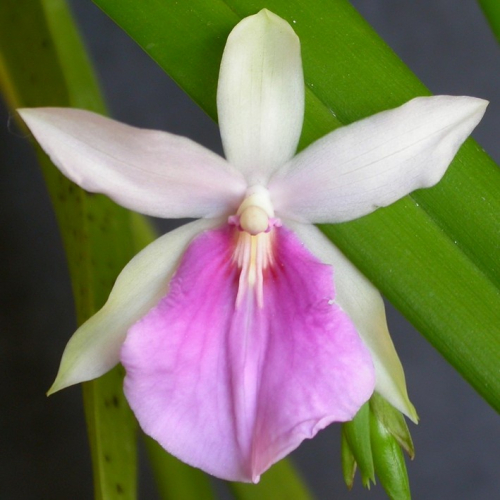
Miltonia hybrid that reaches half a meter across is similar to the pansy in the colouring and called the Pansy Orchid. The differences are, first, that the orchid's corolla is significantly larger (up to 10 centimeters across), and second, the orchid's colouring is dominated by reds and pinks (although there are yellow and cream colours, too). A number of hybrids have a pleasant smell similar to that of the lemon balm.
Secrets to Successfully Growing Miltonia
The plant loves bright light but remember that in its natural habitat, the crowns of phorophites and other trees protect it from direct sunlight. If placed in the southern-facing window in the summer, make sure it is shaded from the sun (even lace curtains will do) and in winter in the moderate climate, it requires supplemental lighting with a fluorescent lamp. Make sure not to overexpose to light. High light levels require intensive air blowing that can not be replaced by drafts because they are disastrous for the plant.
Keep the soil moist, especiallty in the spring and summer. However, soggy and waterlogged soil is extremely dangerous. In the winter, water sparingly. Some experts recommend no watering in the winter.
Miltonia needs high air humidity (60-85%, at least 50%) but never mist the plant! Extra watering cannot be used alternatively to high humidity because the soil becomes waterlogged, root development slows down, and the plant withers slowly and steadily. It is best to place the pot on a tray with water or with moisturizing media (moss, expanded clay, sand, or pebbles).
The best temperatures are 22-26 ° C in the summer (not below 17 ° C at night) and 18-22 ° C in the winter (in any case not less than 12 ° C). Sudden fluctuations in temperature are absolutely not allowed.
You can consider placing your plant into a propagating case with steady temperatures and air humidity for the winter. If these conditions are supplemented by bright artificial light, the so-called resting period in the annual life cycle will be missing. How will the plant respond? You might want to experiment.
Feed your plant with either an orchid fertilizer or a solution of compound fertilizer at 25-50% strength:
- In the period of growth, budding, and flowering every 2 weeks.
- In the resting period from October to February no more than once per month.
Miltonia (like all orchids) is repotting-sensitive so do not repot often. Check to make sure that 1) the soil is not salt accumulated and compacted; 2) the plant is not rootbound. About 3-4 years after planting, the roots will start bulging out of the pot. This is a signal to repot. However, a new pot should not be too large, otherwise the growth will slow down.
The potting mixture should be acidic (pH = 3.0-5.0) or slightly acidic (pH = 5.0-6.0). You can prepare it by mixing sphagnum moss and fern roots at 1:2. Fern roots can be replaced with 0.5-1.5 centimeter pine bark pieces together with dry leaves. You can also add charcoal. There are also more complicated mixtures. You might also want to buy orchid-specific potting soil mix.
When repotting, make sure not to damate the roots. You may gently remove dead root, though.
Miltonia can be propagated by division during repotting, pseudobulbs (fancy trying?), or air layering.
Regular pruning is not necessary for Miltonia.
Potential Problems
Waterlogging threatens with root rot. Take first aid measures by removing the plant, washing and disinfecting the pot, and filling it with fresh soil.
If the soil and air are too dry, the leaves twist and become deformed.
Miltonia can get whiteflies, thrips, mealybugs, scale insects, coccidae, and slugs. If the temperatures are too high and the air is too dry, Miltonia is prone to spider mites.

 5 352
5 352


