


Indoor plants Peperomia
Description
Special Features of Peperomia
Peperomia is a genus of perennial evergreen herbaceous and subshrub plant of the family Piperaceae. The genus consists of an enormous number of species, about 1,000, found across tropical and subtropical regions of Americas and Asia. Peperomias grow on standing trees and felled rotting tree trunks, sometimes on the rocks, but thrive on loose peat soils under a shady canopy. Peperomia is a compact plant 15-50 centimeters tall with beautiful foliage that makes it popular among indoor plant lovers and experts.
Some sources speak of more than six hundred (!) Peperomia's species varying considerably in appearance. Below you can find a list of the best known species, which can help to demonstrate the diversity:
Peperomia velutina is a shrub with heart-shaped or oblong oval leaves that are glossy, dark olive green and have reddish petioles.
Peperomia glabella is an herb with creeping or trailing pinkish green stems.
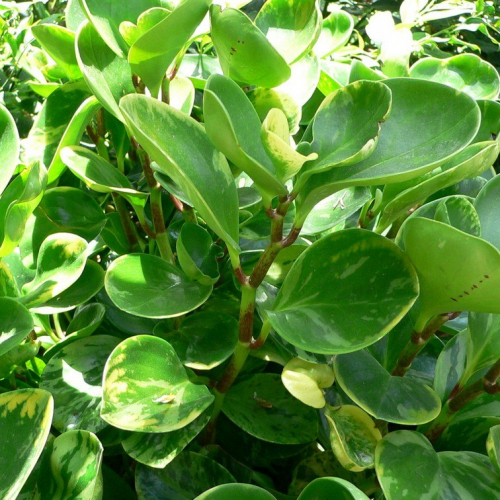
Peperomia clusiaefolia has fleshy but rigid oval brilliant green leaves up to 15 centimeters long and 8 centimeters wide with a narrow purple border. The variegated form has a wide, yellowish white border with a purple ridge.
Peperomia rubella has subtle red shoots and small oblong oval leaves, green on the upper side ad reddish on the underside.
Peperomia rotundifolia has creeping stems and leaves of only 1 centimeter long.
Peperomia serpens is a creeper with small light green leaves on long pinkish green stems. The variegated form has fleshy yellowish white stems and light green (or even milky green) leaves with random creamy white stripes.
Peperomia magnoliaefolia occurring in Panama, the Antilles, and northern South America (Colombia, Venezuela, Guiana), has abundantly branching fleshy reddish stems. The leaves are typically shaped, glossy, solid green, while the variegated form has scattered variously shaped white and yellow patches.
Peperomia pereskiafolia has long bluntly ribbed stems (first erect, then going downwards and taking root) with very tough leathery dark green leaves, each containing three arc veins.
Peperomia sandersii is a stemless but very beautiful plant. Each of the bright green shield-like leaves up to 4 centimeters long has variously sized silver segments.
Peperomia argyreia is also native from the north of South America. It has fleshy rounded oval green leaves up to 12 centimeters wide with silver stripes between veins and long luscious pinkish purple petioles. The underside of the leaves is pinkish red. The inflorescence is about 10 centimeters long, similar to the plantain ears but collected in a 2-3-piece spike reaching 15 centimeters tall. The flowers are white and / or green.
Peperomia griseoargentea has grey green leaves with silvery sheen.
Peperomia caperata draws attention with its wrinkled leathery shield-like leaves up to 3.5 cm long and 3 cm wide. The upper side of the leaves is dark green with brown veins. The underside is reddish. The flowers are snow white. The variegated form has light creamy leaf edges.
Peperomia obtusifolia has glossy dark green elliptical leaves with short petioles, reddish stems, and inflorescences about 8 centimeters long. The leaves of the variegated form are speckled with yellowish creamy stripes and spots, and in variety Aurea the leaves surprise with golden mosaics.
Peperomia fraseri is characterized by white leaves gathered in a rosette.
For the sake of brevity, we have deliberately excluded from the list the information about such species as Peperomia marmorata, Peperomia verticillata, Peperomia blanda, Peperomia maculosa, Peperomia resedaeflora, Peperomia incana, Peperomia prostrata ... Their Latin names are eloquent enough.
The word "Peperomia" is of the Greek origin and means "similar to pepper". The plant's common name is Pepper Face. The reference to pepper in both cases is due to the fact that after flowering in the spring and summer, fruits that are similar to small dried berries appear and ripen on the spikes, ready to fall off under a touch.
The Secrets to Successfully Growing Peperomia
The lighting conditions depend on the variety. Peperomias with dark green leaves can grow in light shade while variegated forms are light-requiring. A universal solution for the summer is bright filtered light with protection from direct sunlight. In the resting period from October to February, ensure sufficient artificial lighting, otherwise the leaves will grow small and lose their vibrant colouring.
Watering in the spring and summer should be moderate. Avoid the soil drying off completely. It is believed, however, that the species with fleshy leaves can withstand small periods of drought. Watch the soil top and water as soon as it dries out a little. Likewise, do not overwater. In the winter, it is recommended to use lukewarm water and make the intervals between waterings slightly longer. Make sure to regularly water small-leaved and low-size species.
Air humidity is not critical for Peperomia. Their succulence helps them to tolerate temporary dry air. In the summer, you can occasionally mist the leaves, especially if they are not downy. Wipe large leaves with a damp sponge. In the winter, stop misting the leaves and the air around the plant.
The best temperatures are 18-25 ° C in the summer and 16-20 ° C in the winter.
In the period of active growth from March to August make sure to feed once every 2 weeks because a lack of nutrients in the soil makes the young leaves shrink. Apply specific liquid houseplant fertilizer or a solution of compound fertilizer at half-strength. In the resting period reduce the feeding frequency to once a month.
Respot each spring or every other spring or even less frequently, only when the plant is potbound, the growth slows down, and leaves do not look healthy. Use a smallish new pot matching the size of the root system. Good drainage is required. Peperomia does not have any special requirement to the potting soil. Perhaps, it is necessary to know one single requirement. Small-leaved and low-size species prefer loose soil. The optimal composition is equal-parts loam, peat soil and sand (1:1:1). You can add rotted cow manure.
Shrub-type Peperomias are propagated by tip and leaf cuttings, erect and creeping species are propagated by stem cuttings. Cuttings root well at a temperature of 20-25 ° C in soil, wet sand, and even in water.
You can also propagate Peperomia by dividing at potting time and (rarely) by seed.
Regularly prune or pinch tips to induce plants to become bushier.
Potential Problems
Make sure to stick to the recommended temperatures and never go beyond the limits because the temperature of 27 ° C or more will affect Peperomia and the plant is not cold-resistant (they can not withstands temperatures below 12 ° C). To avoid low temperatures, select a place safely protected from drafts, otherwise leaves will wither and drop.
Waterlogging together with low soil temperatures, especially in the winter, will cause lots of problems. The leaves get discoloured and wilt (or, which is even worse, turn black and drop; nasty spots will appear on the leaves and stems; cork-like growth will develop on the undersides of leaves. These are the symptoms of root rot.
If the plant suddenly drops the leaves, the cause can be cold air (if in the winter) or underwatering.
Overwatering will cause stems to soften and the leaves to lose turgor, turn black, and drop.
If the leaf tips and edges turn brown, the reason is again cold air or sudden drops in temperature.
The leaves are wilting and pale if the plant is exposed to direct sunlight. If any yellow spots develop and then turn brown, this is a sign of sunburn.
If you over-feed your plant, the leaves may turn yellow or get rusty spots.
Sometimes Peperomia can be affected by mealybugs.
In general, of course, this plant can be regarded as low-maintenance.

 15 736


