


Indoor plants Yucca
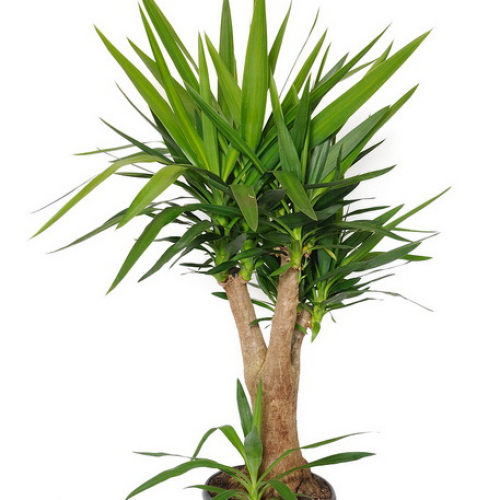
Description
Characteristic Features of Yucca
Yucca is a genus of evergreen trees of the agave family Agavaceae. Yuccaceae was previously treated as a separate family but according to the latest APG III system published in 2009, it was announced a subfamily in the family Asparagaceae. Genus Yucca consists of three sections:
- Tue Yucca with 11 species, including Yucca aloifolia with berry fruits, Yucca gloriosa with dry, spongy, not fleshy fruits, Yucca schidigera, and Yucca baccata.
- Chaenocarpa comprising 17 species. They include, among others, Yucca filamentosa with fruit boxes and Yucca glauca.
- Clistocarpa consisting of a single species, Yucca brevifolia, commonly referred to as Joshua Tree.
In the wild, these succulents storing moisture in their trunks are native to Central America (including the Caribbean area), Mexico, and southern US states. However, a conclusion that Yucca is very heat-loving is wrong. It turned out that many species can easily overwinter outdoors in in the southern part of Europe.Yucca rostrata, Yucca brevifolia, Yucca radiosa, Yucca recurvifolia, Yucca treculeana, Yucca schottii and others can be grown in the southern regions of Russia.
For indoor cultivation, the following species are used: Yucca aloifola, a tree growing 2-6 meters tall, also commonly called a Palm Lily, Yucca filamentos, an acaulescent plant with an underground rhizome and several rosettes of rigid leaves 30-60 centimeters long, Yucca elephantipes, a tree 4 to 8 meters tall, and Yucca australis, a giant growing 8-10-meters in height.
Slow growth of the plant is compensated for by its beauty. Both foliage and flowers opening and fragrant at night are attractive. The plants are pollinated by small female butterflies Tegeticula yuccasella. Unfortunately, they are not found in European gardens; therefore, Yucca can not be expected to bear fruit to the east of the Atlantic Ocean.
Yucca is sometimes referred to as a Miracle Tree, probably due to the fact that a piece of the trunk placed in the warm soil will first produce leaves and then mobilize remaining forces and nutrients to develop roots. If the soil temperature is not sufficient, the cutting will die. There is no point is watering and / or feeding it. After all, it will not assimilate water or food without roots.
The origin of yet another name of a Spanish dagger is self-explanatory. The leaves are thin, straight, and narrow, with pointed tips. By the way, they are prickly so keep the plant out of the reach of children and / or pets.
The Secrets to Successfully Growing Yucca
Yucca thrives in bright filtered light. Protect it from the direct sunlight in the afternoon.
From the spring to autumn, water it plentifully but not excessively. The soil must not be soggy. Allow the top soil to dry out between waterings.
The higher the temperature is, the higher air humidity should be. The plant responds well to misting. Place the plant on a tray of wet pebbles but do not allow water to stagnate.
The best temperatures are 20-25 ° C in the summer and 16-18 ° C in the winter.
In the growing season, fertilize your plant every two weeks with a diluted solution of compound mineral fertilizer with addition of organic fertilizer. During the resting period from October to February, do not feed Yucca.
Repot young specimens once every 2 years and mature plants even less frequently, preferably in the spring. The soild should be lightweight, nutritious, and slightly acidic (pH = 5.0-6.0). The simplest mix is equal-parts loam, leaf mold, and sand (1:1:1). For young plants, you can add humus (You might want to experiment with the amount). For mature plants, double the share of loam.
Yucca is propagated by rooting cuttings in the spring. You can use either trunk cuttings at least 10 centimeters long or tip cuttings. Some species can be propagated by seeds and suckers.
Pruning is performed to change shape, e.g. to turn a trivial shape of a trunk with a crown of leaves into a palm tree with a few crowns. Ideally, it should be done in spring. The plant should be at least 50 centimeters tall. Water the plant well 1-2 days before cutting off the crown. Let both cuts dry. Cover the one on the stem with garden pitch or molten wax. Powder the one on the tip with coal and use it for propagation. Remove the pot with the decapitated trunk from under the bright light and place it in a warm place. Do not water it for six to eight weeks. By the end of this period, buds will develop at the top of the trunk and new tips will sprout.
Potential Problems
The plant is afraid of sharp fluctuations in air and soil temperatures and may die at low temperature. Overwatering during the cold season is undesirable.
Dry discoloured spots on the leaves are an evidence of sunlight burn.
Dry, brown leaf tips indicate too low air humidity or (if air humidity is right) cool drafts aggravated by underwatering.
If the leaves are soft and twisted and leaf tips turn brown, the temperature is too cold for Yucca. Carefully use a bulb with a reflector for heating.
Yellowing leaves are a sign of natural ageing of the plant.
The worst enemies among pests are scale insects and soft scale visible to the naked eye and invisible spider mites.
The latter live on the upper sides or undersides of the leaves. The affected plant slows or entirely stops growth; the leaves dry out and die. Control the pests by spraying the plant with Actellic solution (10 drops per half a liter of water) and clean the leaves on both sides with a sponge soaked in the same solution. Try removing brown scales under which females hide larvae, though they are difficult to scrape off.
The latter prefer to the undersides of the leaves. The foliage turns pale green with a yellowish tinge; discoloured spots develop on the surfaces of the leaves. A sure sign of infestation is fine webbings. Dry air contributes to the infestation, and the leaves can die off completely. Apply insecticides (Phitoverm, Actellic solution or Malathion) and increase humidity.

 321
321


